
Das Salzburger Adventsingen 2026
The big secret
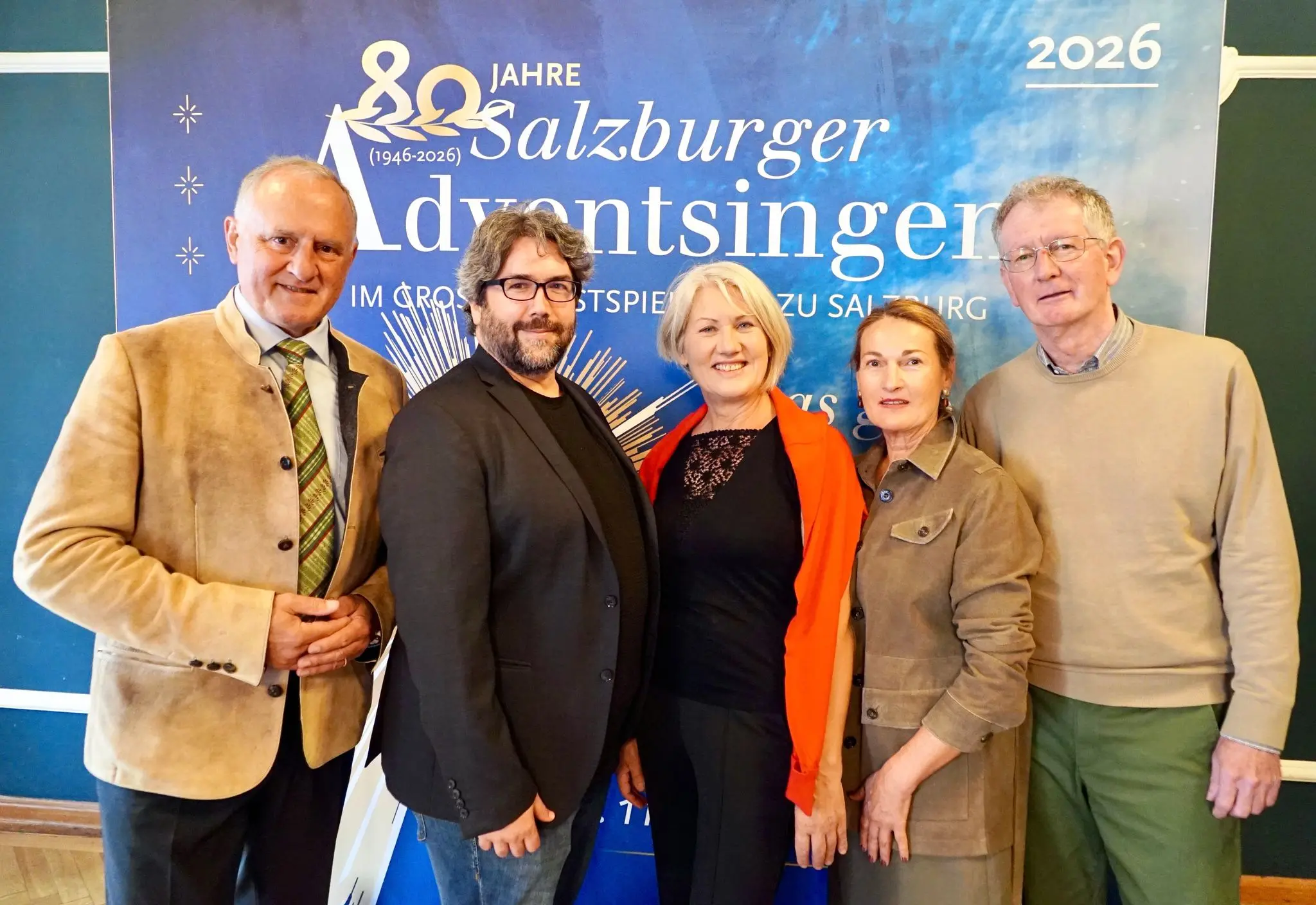
What the Christmas story tells us today
The search for the origin of life and the miracle of birth have occupied Hans Köhl for many years. His deeper exploration of fundamental questions regarding human existence and the divine began back in 2003 with the work “… denn Gott ist die Liebe” (“… for God is Love”). In “Das große Geheimnis” (“The Great Secret”), he revisits these reflections.
Female figures carry particular weight in this production: Mary, Elizabeth, the Angel, and the Narrator have a strong presence throughout the story. Through this, Köhl sets a conscious symbol for the importance and equality of women.
For drama director Gerda Gratzer, who has been responsible for the scenic staging since 2022, this anniversary production also marks her final year with the Salzburg Advent Festival (Salzburger Adventsingen). The focus of her work centers on what meaning the birth of Christ and its associated values hold today. The Angel accompanies the action as a guiding spirit, connecting the Narrator in particular with the spiritual dimension of the events. Mary and Joseph appear this year as confident, festively attired figures. Yet, assistance and welcome are initially denied to them. The shepherds, by contrast, meet them with openness. These contrasting reactions highlight how human solidarity reveals itself in everyday life.
The big secret leads into the heart of Salzburg's historic centre.
In this anniversary year, Hans Köhl marks his farewell with “Das große Geheimnis” (“The Great Secret”)—a production that grounds the Christmas story right in Salzburg. Reflecting on his 27-year tenure as artistic director and overall creative manager, the piece unites key elements from his decades of work.
During mid-October’s press briefing, the artistic team shared an initial look into the story, musical design, and scenery. Their preview highlighted how seamlessly every aspect connects: memories of Salzburg in decades past weave together with the biblical story and enduring human questions.
A Familiar Town and an Age-Old Tale
After settings in the Judean vineyards or the mountains of the Dachstein massif, Hans Köhl returns to the geographical origin of the Salzburger Adventsingen with his anniversary work. The story begins with a Salzburg woman’s memories of the Advent season several decades ago, when it was still quieter and darker around the Residenzplatz.
The narrator, portrayed by Martina Auer, guides through the events from a modern-day perspective. Through her eyes, a city unfolds where different worlds collide: shepherd children from the Gaisberg and Untersberg mountains search for their lost sheep and find shelter with Rabbi Jakob, played by Edwin Hochmuth. It is there that they also encounter Mary and Joseph. From these meetings, a narrative unfolds about helpfulness, humanity, and the search for what truly matters.
For the shepherd children, the unfamiliar city setting becomes an experience in itself. With curiosity, they explore its alleys and squares, repeatedly bringing liveliness and humor to contrast with the quieter, more reflective moments.
Eight Decades of Music
The music likewise reflects the history of the Salzburger Adventsingen. Shane Woodborne, collaborating with Hans Köhl for the eleventh time, combines new compositions and arrangements with works by composers who have shaped the Advent Festival over decades. For this anniversary production, he has newly composed or arranged around 15 musical numbers.
These include the prologue “Salzburg im Advent” (“Salzburg in Advent”), musical settings of texts by Wilhelm Willms and Clemens Brentano, as well as numerous orchestrations. Traditional Alpine folk music sits alongside works by Tobi Reiser, Wilhelm Keller, and César Bresgen, alongside compositions by Klemens Vereno and Peter Wesenauer. Reflections by Karl Heinrich Waggerl from 1956 have also been incorporated into the libretto.
The basset horn adds a new tonal color as a fresh addition to the instrumental ensemble this year. The Salzburg shepherd children contribute significantly to the musical narrative through their singing and playing. Their repertoire includes the demanding “Grödiger Walzer”, an Aberseer Landler, and “Hirten Stille Nacht”—a special arrangement of the cherished Christmas carol.
An Anniversary and a Personal Farewell
Since Tobi Reiser the Elder founded the Salzburger Adventsingen in 1946, a small folk culture gathering has grown into an internationally renowned cultural event. More than two million people have attended the performances over the course of these eight decades. Since 1960, the Grosses Festspielhaus (Large Festival Hall) has been an integral part of this story.
In this anniversary year, another milestone approaches: on Saturday, November 28, at 5:30 p.m., the 1,000th performance at the Grosses Festspielhaus will take place. For Hans Köhl, this milestone coincides with the conclusion of his tenure as artistic director. “With this anniversary work, my 27-year tenure as director of the Salzburger Adventsingen comes full circle,” he says.
“Das große Geheimnis” (“The big Secret”) premieres on November 27 and runs at the Grosses Festspielhaus through December 13.
Salzburg Like in Old Photographs
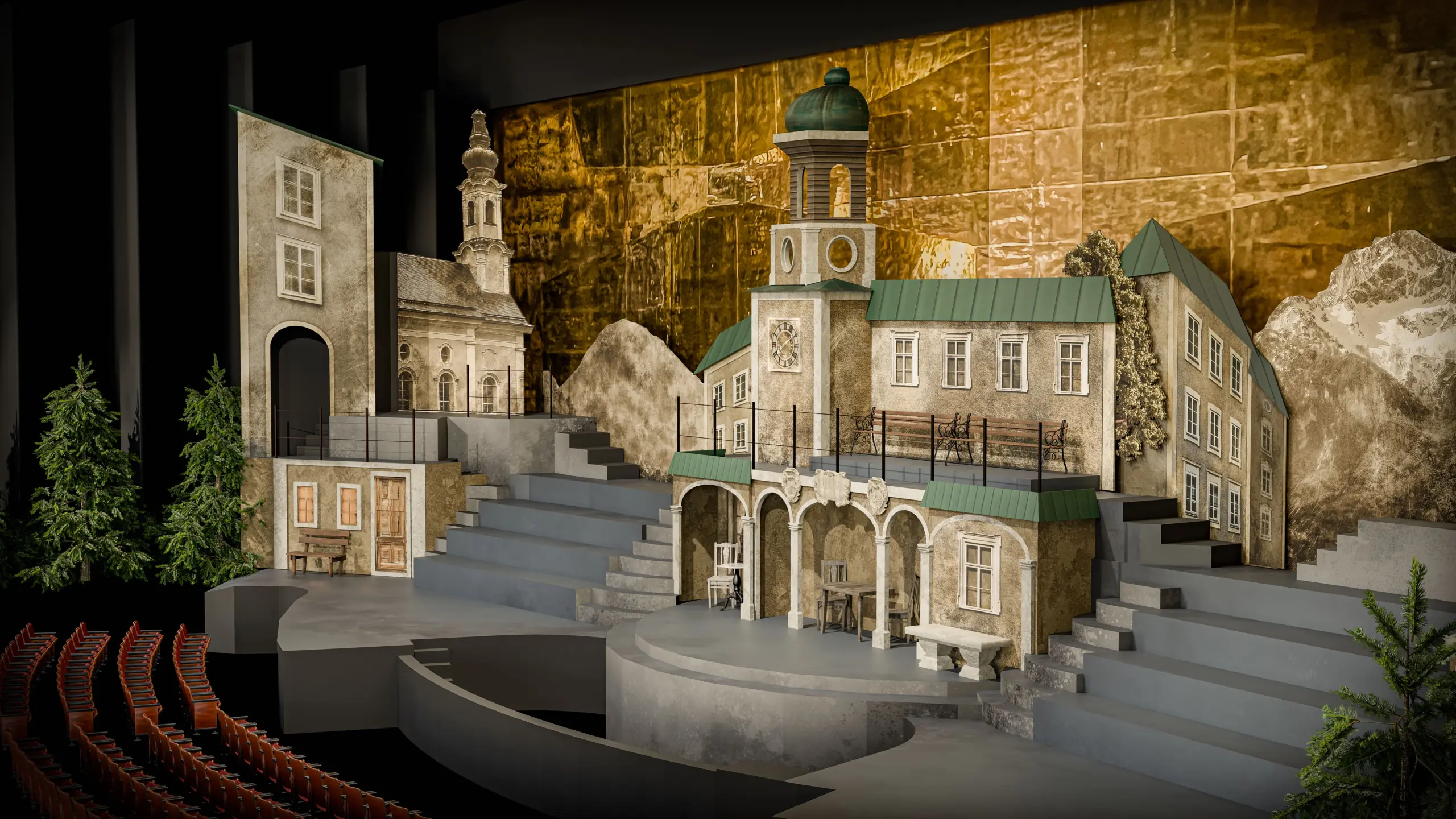
For the stage design, Andreas Ivancsics studied Salzburg’s Old Town and its buildings in great detail. The carillon of the New Residenz and the facade of the Salzburger Heimatwerk will be clearly recognizable on stage. Their design is inspired by the look and feel of historical photographs. Sepia and brown tones, copper-green roofs, and subtly applied signs of aging recreate a Salzburg of decades past.
The sets are being built primarily using classical construction methods and painted by hand, realized in collaboration with the Alfred Laserer joinery from Gosau. The challenge lies in translating the familiar views of the city onto the relatively shallow stage depth of the Grosses Festspielhaus.
Costume designer Brigitte Schiebler reflects this visual language using natural materials and coordinated colors. Linen, wild silk, and handcrafted details define the garments. Mary wears embroidered silk fabrics in rich red tones, while Joseph and Elizabeth wear long coats. The narrator appears in a Paisley-patterned dirndl, and the Angel in embroidered cotton and airy silk chiffon.